Typography
Typography is organizing textual communication. This includes creating a typographic palette that aligns with the functional and aesthetic demands of what is being communicated.
It also includes the development of a sound formal hierarchy to stimulate an optimal understanding of the content. The correct and consistent appliance of typography ensures a recognizable tone of voice that supports the message and contributes to the brand experience.
Typeface#
Neue Haas Unica#
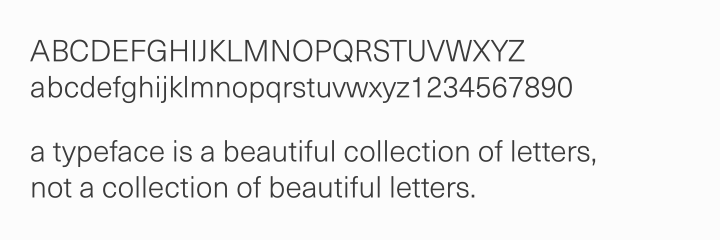
Neue Haas Unica is the main font of Wielfaert Architecten. We appreciate its modernist roots, warmth, and composure.
Wielfaert Architecten primarily uses the Light weight for both bodytext and headings. In complex publications where compositional means of creating hierarchy does not suffice, the Medium weight can be added for headings.
Neue Haas Unica is designed by André Gürtler, Erich Gschwind, Christian Mengelt, and Toshi Omagari and published by Linotype. Desktop- and webfonts are available via Adobe Fonts.
Get Neue Haas UnicaSemantics#
Emphasis & italics#
Keeping the same weight and color, we change the style to italics.
Hyperlinks#
The color Sand can be used to indicate interactivity. See Colors
Inline separations#
When separating semantic units on a line, use the bullet operator (unicode 2219).
Usage#
Alignment#
In order to ensure a clear, contemporary looking and calm reading experience, all running text should be left-aligned.
Line length#
If a line of text is too long, the reader’s eye will have a hard time focusing on the text. A line that is too short will cause the eye to travel back too often, breaking the reader’s attention.
Using Neue Haas Unica for bodytext, we regard 55 characters (including spaces) as an ideal length of line. For multiple column work, a better average is 40 to 50 characters.
Casing#
Use sentence case only. In sentence case, only the first word of a sentence and proper nouns have initial capitals. An exception is made for the wordmark, headings, and navigational typography: here we can use lowercase for stylistic reasons.